Swing Trading Stocks: A Beginner’s Strategy Guide

Swing trading means holding a position for several days to a few weeks to catch a medium-term “swing” in price. It sits between fast-paced day trading and long-term investing — and because it needs far less screen time, it’s popular with people who trade around a job. This guide covers how it works, beginner strategies, and the risks.
What is swing trading?
Swing trading aims to capture a chunk of a price move over days to weeks, rather than minutes (day trading) or years (investing). You enter when a stock looks ready to move, hold through the swing, and exit when the move slows or hits your target.
The appeal is time: you might check charts for 20–30 minutes a day rather than watching every tick. The trade-off is overnight risk — you hold through closes, so gaps and news can move your position while you’re away.
Swing trading vs day trading
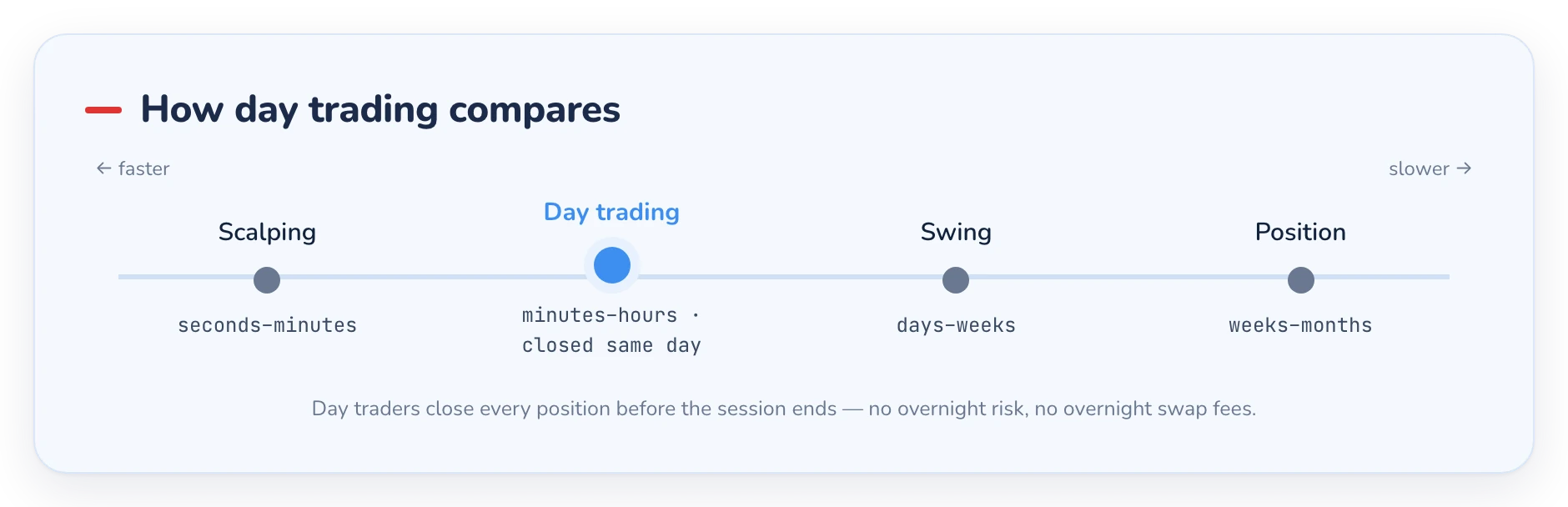
| Day trading | Swing trading | |
|---|---|---|
| Hold time | Minutes–hours | Days–weeks |
| Screen time | High | Low |
| Overnight risk | None | Yes |
| Trades per week | Many | Few |
| PDT rule (US stocks) | Applies ($25k) | Usually not |
For most people balancing a job, swing trading is the more realistic starting point. See day trading for beginners for the faster alternative.
Beginner swing trading strategies
- Trend pullbacks. In an uptrend, buy when price dips to a support level — often the 20-day or 50-day moving average — and bounces, ideally with the 14-period RSI turning up from near 40. You trade with the trend, not against it.
- Breakouts. Enter when a stock clears a clear resistance level on strong volume (say, 1.5× its recent average), aiming to ride the fresh move.
- Range trading. In a sideways stock, buy near support and sell near resistance — and stand aside once price breaks out of the range.
Our forex trading strategies guide covers these setups in more depth — they work the same on stocks.
How to pick stocks to swing trade
- Liquidity — trade stocks with high average volume so you can enter and exit easily.
- Clear trend or range — a readable chart beats a choppy one.
- A catalyst — earnings, news, or sector momentum can drive the swing.
- Volatility that fits your stop — enough movement to profit, not so much it whipsaws you out.
Managing the risk
- Risk 1% or less per trade, with a stop-loss below support (long) or above resistance (short).
- Mind the gaps. Because you hold overnight, an earnings miss can gap through your stop — size accordingly.
- Aim for a positive reward-to-risk ratio (at least 2:1), so a modest win rate still profits.
Run the numbers. Say a $50 stock pulls back to its rising 50-day moving average. You buy at $50, set a stop at $47 (just below support), and target $56 — a 2:1 reward-to-risk. Risking 1% of a $10,000 account is $100, and your $3 stop distance sizes the trade at about 33 shares. Hit the target and that’s roughly +$200; get stopped out and you lose about $100. (Illustrative — your entries, stops, and share size will differ.)
Mind the undertow. Swing trading carries real risk, including overnight gaps you can’t control. And activity is no guarantee of an edge: Barber and Odean’s study of 66,465 US households (1991–1996) found the most active traders underperformed the market after costs. Trade a tested plan, size small, and only risk money you can afford to lose.
How to start
Practice on a demo account first, then trade small live. Tradeview Markets offers demo and live trading on the MetaTrader and cTrader platforms. New to the mechanics? Start with how to start trading.
Frequently asked questions
Is swing trading good for beginners?
Often better than day trading, because it needs less screen time and fewer split-second decisions. You still need strict risk management and a tested strategy.
How much money do I need to swing trade stocks?
It varies by broker. Notably, US day-trading rules (the $25,000 PDT minimum) usually don’t apply to swing trading, since you’re not making frequent same-day trades.
How long do you hold a swing trade?
Typically a few days to a few weeks — until the move plays out, hits your target, or your stop.
What’s the difference between swing trading and investing?
Swing trading targets short-to-medium price moves over weeks; investing holds for years to build wealth. Swing trading is far more active.
Sources
- FINRA (2024). Extended-Hours Trading: Know the Risks — and the Pattern Day Trader rule for margin accounts. finra.org
- Barber, B. M., & Odean, T. (2000). Trading Is Hazardous to Your Wealth. The Journal of Finance, 55(2), 773–806 — the most active individual traders badly underperformed the market after costs. doi.org
Risk warning. Trading stocks and CFDs carries a high level of risk and may not be suitable for all investors. Holding overnight exposes you to gap risk. This article is for educational purposes only and does not constitute financial advice.
Community
Trading platforms
Services
Articles
Community
Trading platforms
Services


Copyright © 2026. All rights reserved.
There is a risk of loss in trading foreign currencies and it is not suitable for everyone. Tradeview is not responsible for any gains or losses on currency rates or exchanges during any transaction.
The services and products offered by Tradeview are not being offered within the United States (US) and not being offered to US Persons, as defined under US law. The information on this website is not directed to residents of any country where FX and/or CFDs trading is restricted or prohibited by local laws or regulations.
CFDs are complex instruments and come with a high risk of losing money rapidly due to leverage. 64% of retail investors' accounts lose money when trading CFDs with Tradeview. You should consider whether you understand how CFDs work and whether you can afford to take the high risk of losing your money.
Headquarters Tradeview Ltd.: 13 Genesis Close, 4th Floor, Suite 422, Cayman Islands
High Risk Warning: Foreign exchange trading carries a high level of risk that may not be suitable for all investors. Leverage creates additional risk and loss exposure. Before you decide to trade foreign exchange, carefully consider your investment objectives, experience level, and risk tolerance. You could lose some or all your initial investment; do not invest money that you cannot afford to lose. Educate yourself on the risks associated with foreign exchange trading and seek advice from an independent financial or tax advisor if you have any questions.
Advisory Warning: Tradeview provides references and links to selected blogs and other sources of economic and market information as an educational service to its clients and prospects and does not endorse the opinions or recommendations of the blogs or other sources of information. Clients and prospects are advised to carefully consider the opinions and analysis offered in the blogs or other information sources in the context of the client or prospect's individual analysis and decision making. None of the blogs or other sources of information is to be considered as constituting a track record. Past performance is no guarantee of future results and Tradeview specifically advises clients and prospects to carefully review all claims and representations made by advisors, bloggers, money managers and system vendors before investing any funds or opening an account with any Forex dealer. Any news, opinions, research, data, or other information contained within this website is provided as general market commentary and does not constitute investment or trading advice. Tradeview expressly disclaims any liability for any lost principal or profits without limitation which may arise directly or indirectly from the use of or reliance on such information. As with all such advisory services, past results are never a guarantee of future results.