





Why Trade Forex with Tradeview Markets?

A regulated broker
Trade with a company that operates under real regulatory oversight. See regulations.

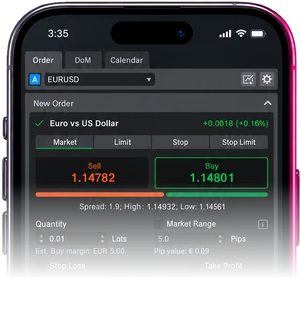
Direct market access
ECN-style pricing on eligible accounts, with no dealing-desk intervention between you and the price you see.

Trade nearly around the clock
The Forex market runs 24 hours a day, five days a week, across four overlapping sessions, see trading hours.

Personalized customer support
A dedicated account manager from the Tradeview team is assigned to your account from day one.
Forex account types built for cost, flexibility, or scale
Not every trader optimizes for the same thing. That's why we built three models, and why picking the right one matters.
New technology built for speed and cost.
It strips the spread down to raw market pricing, adds a razor-thin flat commission, and routes every order through our ultra-low latency, multi-liquidity engine to lock in the tightest price available, even on larger volume.
*Commissions vary based on instrument.
Built for flexibility.
Higher leverage, more room to size your positions the way you want, and the freedom to structure your trading around your own risk appetite, not ours.
Room to scale up.
Maximum leverage, zero commission. Built for traders who want greater exposure per lot and prefer a simple cost built into the spread.

Currency pairs you can trade
Currency pairs are grouped by how heavily they're traded and how directly they involve the US dollar.
How pairs are priced and sized:
Price moves are measured in pips, typically the fourth decimal place of a pair's price (the second, for yen pairs).
Position size is measured in lots:
A standard lot is 100,000 units of the base currency, a mini lot 10,000, and a micro lot 1,000. On most USD-quoted major pairs, that's roughly $10 per pip on a standard lot, $1 on a mini lot, and $0.10 on a micro lot, smaller lots let you scale your position, and your risk, to your account size.
Major pairs
The US dollar paired with the world's most-traded currencies. The highest liquidity and typically the tightest pricing.
- EUR/USD
- GBP/USD
- USD/JPY
Minor pairs
Two major world currencies traded against each other, without the US dollar.
- EUR/GBP
- GBP/JPY
Exotic pairs
A major currency paired with the currency of a developing economy. Typically wider spreads and higher volatility.
- USD/ZAR
- EUR/TRY
Forex trading costs, explained
Three components make up the cost of a forex trade, knowing them upfront means no surprises once you're in a position.
Spread:
The difference between the buy and sell price, measured in pips.
Commission:
On raw-spread accounts, a fixed fee is charged per lot traded, separate from the spread itself.
Overnight/ rollover (swap):
A financing charge or credit for positions held past the daily rollover time, based on the interest-rate differential between the two currencies.

Forex trading sessions and market hours
The Forex market never fully closes on a weekday, as one financial center winds down, another opens. Trading activity moves through four overlapping sessions: Sydney, Tokyo, London and New York.
The London-New York overlap typically sees the highest liquidity and tightest spreads of the day. The quieter Sydney-Tokyo overlap suits a more conservative, lower-volatility approach.
Sydney
Opens the week; lower volume, first to react to weekend news.
Tokyo
Drives most yen activity; brief overlap with Sydney.
London
Largest, most liquid session of the day.
New York
Opens mid-London, creating the busiest overlap.
Choose your Forex trading platform
Trade the same Forex and CFD markets on the platform that fits how you work.
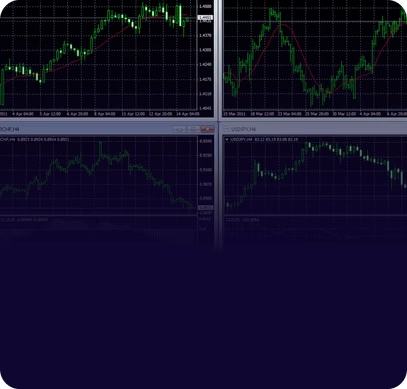

MetaTrader 4
The most widely supported platform for Expert Advisors and automated strategies.
Explore MT4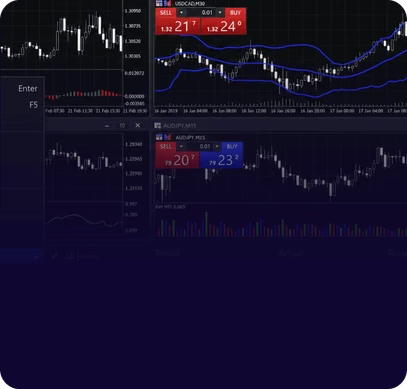

MetaTrader 5
More timeframes, more order types and access to a broader range of asset classes.
Explore MT5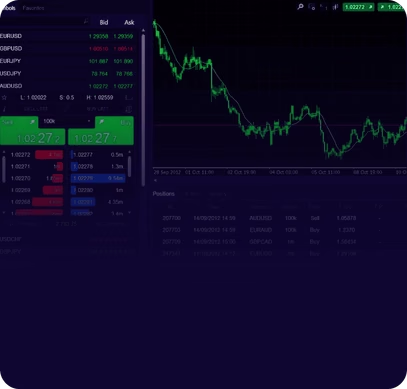

cTrader
ECN-style execution with full Depth of Market and algorithmic trading via cBots.
Explore cTrader


How to start trading Forex
1.
Open your account
Registration and verification only takes a few minutes.
2.
Choose your platform
MT4, MT5 or cTrader, all give you access to the same Forex & CFDs markets.
3.
Fund your account
Choose from Tradeview's available deposit methods.
4.
Set your risk parameters
Decide your position size and Stop Loss before you place your first trade.
5.
Start trading
Access live pricing and your assigned account manager.
How we protect your funds
Trading Forex means trusting a broker with your capital before you place a single trade.
Tradeview keeps client funds segregated from company operating funds, applies dynamic leverage limits to help manage risk on volatile pairs, and backs its platforms with the account security practices expected of a regulated broker.

Forex market analysis and resources
New to Forex or refining your strategy?
Explore our economic calendar for upcoming market-moving events, and our blog for guides on platforms, risk management and getting started.

Forex trading FAQs
Forex trading is the buying and selling of one currency against another, such as EUR/USD, with the aim of profiting from changes in the exchange rate between them.
Forex trading itself is a legitimate, globally regulated financial market. Legitimacy risk comes from the broker you choose, trade only with a broker that operates under real regulatory oversight.
Forex trading can be profitable, but there's no guarantee, losses are possible and leverage can amplify them in both directions. Trade with a clear risk-management plan.
A pip is the smallest standard unit of price movement in a currency pair, typically the fourth decimal place (or second, for yen pairs). It's the standard unit used to measure spreads and price changes.
Lot size is how position size is measured: a standard lot is 100,000 units of the base currency, a mini lot 10,000 units, and a micro lot 1,000 units. Smaller lots scale your trade size, and your risk, to your account size.
Leverage lets you control a larger trading position with a smaller amount of capital, borrowed from your broker. It can magnify both profits and losses.
The market is most liquid during the London-New York overlap, when spreads tend to be tightest and price movement most active. See the full session breakdown above.



Ready to trade Forex?
Open a Live account for real market pricing, or start with a free Demo.


INSTANT LIQUIDITY CONNECTOR


INSTANT LIQUIDITY CONNECTOR
INSTANT LIQUIDITY CONNECTOR