Forex vs Stocks: Which Should You Trade?

Forex and stocks are two of the most popular markets to trade — but they behave very differently. Forex is a 24-hour, highly leveraged market of a few dozen currency pairs; stocks are thousands of individual companies traded during exchange hours. Neither is “better.” This guide compares them so you can pick the one that fits your goals, schedule, and risk appetite.
The key differences
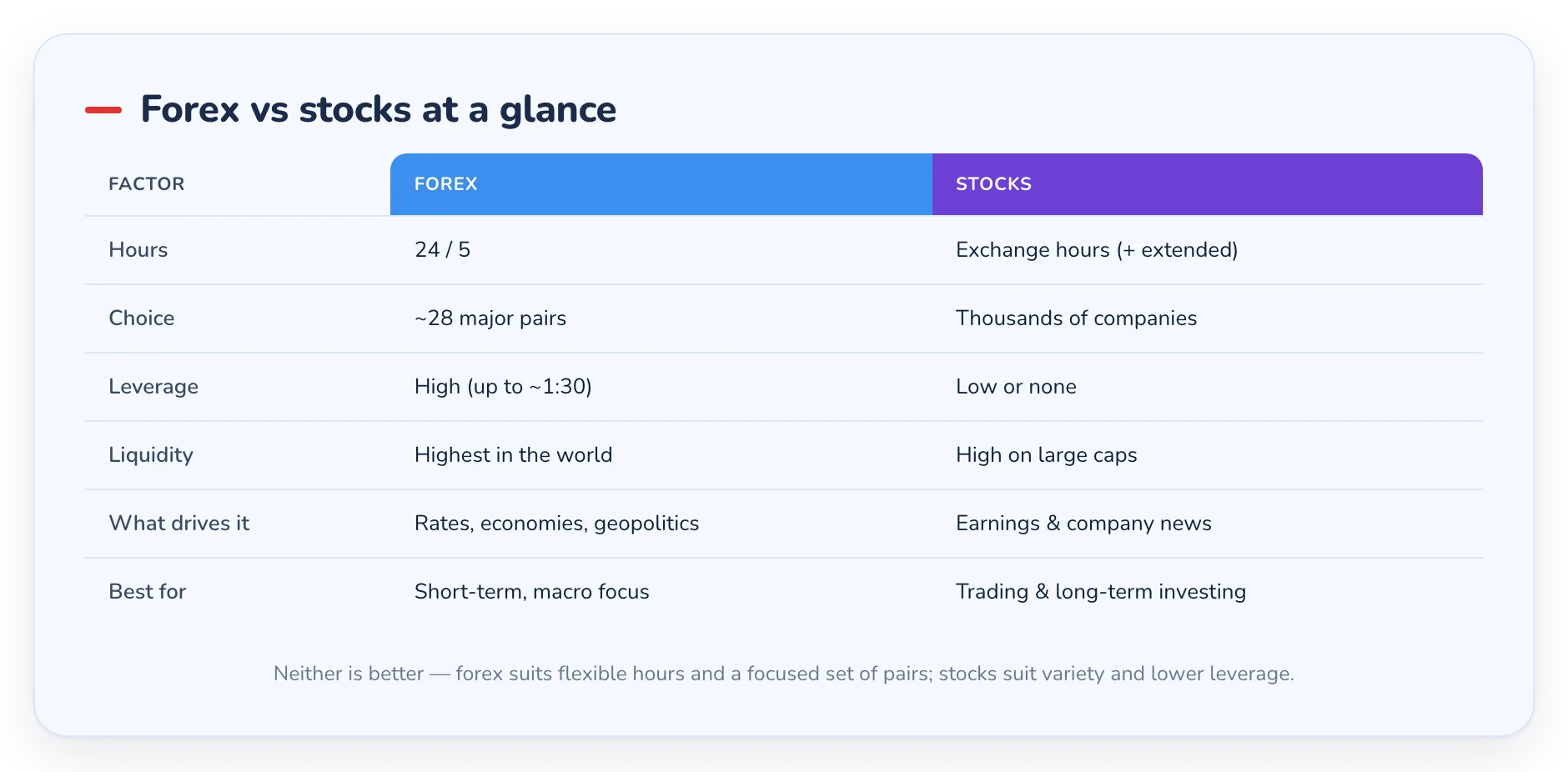
| Factor | Forex | Stocks |
|---|---|---|
| Hours | 24/5 | Exchange hours (+ extended) |
| Choice | ~28 major pairs | Thousands of companies |
| Leverage | High (e.g. up to 1:30) | Low or none |
| Liquidity | Highest in the world | High on large caps |
| What drives it | Rates, economies, geopolitics | Earnings, company news |
| Best for | Short-term, macro-focused | Both trading and investing |
Trading hours
Forex runs 24 hours a day, five days a week, so you can trade around a job or in your own time zone. Stocks trade during exchange hours (9:30 AM–4:00 PM ET for US stocks), plus limited pre- and post-market sessions. If flexible hours matter to you, forex wins; if you prefer a defined trading window, stocks suit better.
Choice and focus
Forex concentrates on a handful of major pairs — you can master EUR/USD and a few others. Stocks offer thousands of companies across sectors, which means more opportunity but also more research. Some traders like the focus of forex; others love the variety of stocks.
Leverage and risk
Forex is typically traded with high leverage, which magnifies both gains and losses — powerful but riskier. Stocks are usually traded with little or no leverage (though stock CFDs add it). More leverage means smaller capital can control a larger position, but it also means faster losses if the trade goes wrong.
What moves each market
- Forex reacts to interest rates, inflation, employment data, and geopolitics — broad, macro forces.
- Stocks react to a company’s earnings, guidance, and news, plus the wider market mood.
If you enjoy following economies and central banks, forex fits. If you’d rather analyze businesses, stocks fit.
Which should you trade?
- Choose forex if you want flexible hours, a small set of instruments to master, high liquidity, and you’re comfortable with leverage.
- Choose stocks if you prefer analyzing companies, want lower leverage, or plan to both trade and invest for the long term.
Many traders do both. The best first step is to pick one market, learn it deeply, and practice on a demo — see how to start trading. Tradeview Markets offers both forex and stock/CFD access on the MetaTrader and cTrader platforms.
Related guides
Frequently asked questions
Is forex better than stocks?
Neither is universally better. Forex offers 24-hour access, high leverage, and a focused set of pairs; stocks offer variety, lower leverage, and long-term investing. The right choice depends on your goals and schedule.
Is forex riskier than stocks?
Forex is often traded with higher leverage, which increases risk. But risk mostly comes from how you trade — position size and stop-losses matter more than the market itself.
Can I trade both forex and stocks?
Yes, many traders do, often from one account. Beginners are usually better off mastering one first before adding the other.
Which is better for beginners?
Both can work. Forex appeals for its low starting capital and focus; stocks appeal for familiarity. Pick one, go deep, and manage risk.
Sources
- Bank for International Settlements (2025). Triennial Central Bank Survey — OTC foreign exchange turnover in April 2025. Global FX turnover reached $9.6 trillion per day. bis.org
- Barber, B. M., & Odean, T. (2000). Trading Is Hazardous to Your Wealth. The Journal of Finance, 55(2), 773–806 — the most active individual traders badly underperformed the market after costs. doi.org
Risk warning. Trading Forex and CFDs carries a high level of risk and may not be suitable for all investors. Leverage can work against you as well as for you. This article is for educational purposes only and does not constitute financial advice.
Community
Trading platforms
Services
Articles
Community
Trading platforms
Services


Copyright © 2026. All rights reserved.
There is a risk of loss in trading foreign currencies and it is not suitable for everyone. Tradeview is not responsible for any gains or losses on currency rates or exchanges during any transaction.
The services and products offered by Tradeview are not being offered within the United States (US) and not being offered to US Persons, as defined under US law. The information on this website is not directed to residents of any country where FX and/or CFDs trading is restricted or prohibited by local laws or regulations.
CFDs are complex instruments and come with a high risk of losing money rapidly due to leverage. 64% of retail investors' accounts lose money when trading CFDs with Tradeview. You should consider whether you understand how CFDs work and whether you can afford to take the high risk of losing your money.
Headquarters Tradeview Ltd.: 13 Genesis Close, 4th Floor, Suite 422, Cayman Islands
High Risk Warning: Foreign exchange trading carries a high level of risk that may not be suitable for all investors. Leverage creates additional risk and loss exposure. Before you decide to trade foreign exchange, carefully consider your investment objectives, experience level, and risk tolerance. You could lose some or all your initial investment; do not invest money that you cannot afford to lose. Educate yourself on the risks associated with foreign exchange trading and seek advice from an independent financial or tax advisor if you have any questions.
Advisory Warning: Tradeview provides references and links to selected blogs and other sources of economic and market information as an educational service to its clients and prospects and does not endorse the opinions or recommendations of the blogs or other sources of information. Clients and prospects are advised to carefully consider the opinions and analysis offered in the blogs or other information sources in the context of the client or prospect's individual analysis and decision making. None of the blogs or other sources of information is to be considered as constituting a track record. Past performance is no guarantee of future results and Tradeview specifically advises clients and prospects to carefully review all claims and representations made by advisors, bloggers, money managers and system vendors before investing any funds or opening an account with any Forex dealer. Any news, opinions, research, data, or other information contained within this website is provided as general market commentary and does not constitute investment or trading advice. Tradeview expressly disclaims any liability for any lost principal or profits without limitation which may arise directly or indirectly from the use of or reliance on such information. As with all such advisory services, past results are never a guarantee of future results.