Fixed Foreign Exchange Rate Explained: How Currency Pegs Work and Break

A fixed foreign exchange rate is a currency price set by policy rather than by the market. A government or central bank ties its currency to an anchor, usually the US dollar or the euro, and then buys or sells currency to hold the price at that level. It is also called a pegged exchange rate or a currency peg. Hong Kong is a well-known example: it has run its Linked Exchange Rate System since 1983, and the system keeps the Hong Kong dollar between HK$7.75 and HK$7.85 per US dollar.
What is a fixed foreign exchange rate?
A fixed exchange rate has three parts:
- The anchor: the currency or basket that the home currency is tied to. Of the 81 economies that the International Monetary Fund (IMF) lists with an exchange-rate anchor, 38 use the US dollar and 25 the euro.
- The parity: the official price, or central rate. Saudi Arabia's parity is 3.75 riyals per US dollar.
- The band: how far the market price may move from the parity. Denmark lets the krone move up to 2.25% either side of its central rate against the euro.
The central bank makes the price credible by standing ready to trade at it. Most major currencies in the forex market float, so a peg is a deliberate choice.
In Plain Terms
Fixed and pegged usually mean the same thing: policy, not the market, sets the price. A floating rate is set by supply and demand. A managed float sits in between: the market sets the price, but the central bank leans against moves it dislikes without defending one level.
Pegs are normally quoted with the anchor currency first. USD/HKD at 7.80 means one US dollar costs 7.80 Hong Kong dollars. Our guide to the base currency explains which side of a quote is which.
A short history of fixed rates
Under the Bretton Woods system that followed the Second World War, other currencies were fixed against the US dollar, and the dollar was fixed to gold at $35 an ounce. On 15 August 1971, President Nixon suspended the dollar's convertibility into gold. In March 1973, the Group of Ten agreed that six European currencies would float jointly against the dollar, which in effect ended the Bretton Woods fixed-rate system.
Fixed vs floating vs managed exchange rates
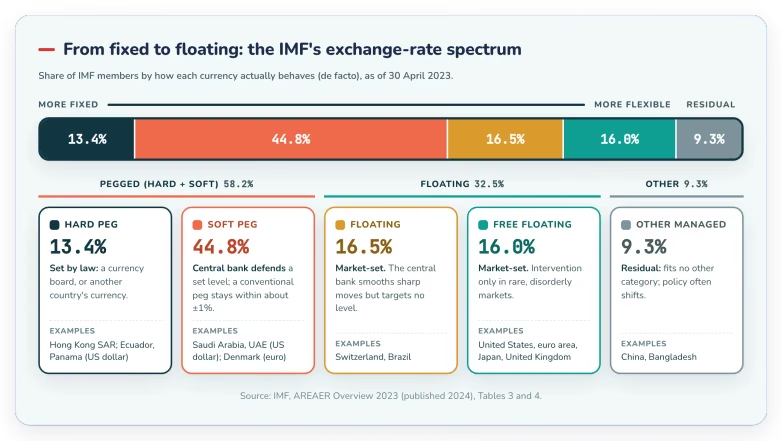
Exchange rate regimes differ in who sets the price and how far it can move. The IMF sorts its members into 10 categories in four groups, judged by what each currency actually does, not only by what governments announce.
| Group | Who sets the price | How much it moves | Examples (IMF, April 2023) |
|---|---|---|---|
| Hard peg | The law: a currency board, or no national currency at all | Very little, or not at all | Hong Kong (currency board); Ecuador, El Salvador, Panama (use the US dollar) |
| Soft peg | The central bank, at a set level or along a set path | A conventional peg stays within about ±1% of its parity | Saudi Arabia and the UAE (US dollar); Denmark (euro) |
| Floating | The market, with official smoothing of sharp moves | Freely, with no target level | Switzerland, Brazil |
| Free floating | The market; intervention only in disorderly conditions | Freely | United States, euro area, Japan, United Kingdom |
| Other managed | Mixed or often-changing policy | Varies | China, Bangladesh |
As of 30 April 2023, 44.8% of IMF members had a soft peg and 13.4% a hard peg, so 58.2% ran some form of peg. Floating regimes covered 32.5% and “other managed” 9.3%. Many small economies peg; the largest currencies float.
The US dollar itself is free floating, according to the IMF. A currency pegged to it, such as the Saudi riyal, therefore moves with the dollar against the euro, the yen and everything else.
How a central bank holds a peg
A peg is a standing promise to trade at a price. The IMF's definition of a conventional peg names two kinds of tools: direct intervention, which means buying or selling foreign currency, and indirect intervention, such as interest-rate policy, foreign-exchange rules and moral suasion.
| Tool | How it supports the peg | Real example |
|---|---|---|
| Intervention | Buy the home currency when it is weak; sell it when it is strong | The UAE central bank buys dirhams at 3.673 and sells them at 3.672 per US dollar |
| Reserves | A stock of foreign currency that funds the buying | UAE law requires foreign reserves worth at least 70% of the monetary base |
| Interest rates | Keep local rates in line with the anchor, so money has no reason to rush in or out | The UAE’s Base Rate is aligned with the Fed’s interest rate on reserve balances; Denmark’s central bank adjusts rates to steady the krone |
| Capital and FX rules | Slow money down as it tries to leave | The IMF lists foreign-exchange regulations among the tools of indirect intervention |
The impossible trinity
A country cannot have a fixed exchange rate, free movement of capital and an independent monetary policy all at once. It must give one up. The UAE central bank uses this impossible trinity to explain why its policy rate follows US rates: a country that pegs and keeps its capital markets open borrows the anchor's monetary policy, even when its own economy needs something else.
Why defending against a fall is harder
To stop a fall, a central bank sells foreign reserves, and reserves can run out. To stop a rise, it sells its own currency, which it can create. That is how the Swiss National Bank (SNB) could promise in 2011 to buy foreign currency in unlimited quantities to cap the franc. Even that promise had costs, and in 2015 the SNB judged it no longer justified.
The Takeaway
A peg lasts only while the central bank is able and willing to trade at the promised price. Reserves, interest rates and capital rules are the tools; the market's belief that the bank will use them is what keeps the price still.
Fixed exchange rate examples today
Figures checked at each central bank in October 2026. Pegs change by policy decision, so check the central bank's own page before you rely on a rate.
| Currency | Anchor | Official rate or band | IMF class (April 2023) |
|---|---|---|---|
| Hong Kong dollar (HKD) | US dollar | HK$7.75–7.85 per US$1 | Currency board |
| Saudi riyal (SAR) | US dollar | 3.75 per US$1 | Conventional peg |
| UAE dirham (AED) | US dollar | 3.6725 midpoint (deals at 3.672 and 3.673) | Conventional peg |
| Danish krone (DKK) | Euro | 746.038 per €100, ±2.25% | Conventional peg |
Hong Kong. The Hong Kong Monetary Authority (HKMA) describes its Linked Exchange Rate System, in place since 17 October 1983, as a currency board that keeps the Hong Kong dollar within HK$7.75–7.85 per US dollar. A currency board is the strictest kind of peg: the exchange promise is set in law, and local money is usually fully backed by foreign assets. The whole band is 0.10 Hong Kong dollars wide, about 1.3% of the rate.
Saudi Arabia and the UAE. Both peg to the US dollar. In August 2016, when traders were betting against the riyal in the futures market, the Saudi Central Bank (SAMA) restated its commitment to 3.75 riyals per dollar. It said the bets rested on incorrect information and noted that the fixed rate had been in place for more than three decades. The UAE central bank publishes its exact dealing prices.
Denmark. Danmarks Nationalbank has run a fixed exchange rate policy since 1982. In ERM II, the EU's exchange rate mechanism, the krone's central rate is 746.038 kroner per 100 euros, with a ±2.25% band (729.252 to 762.824). In practice it stays far closer: European Central Bank (ECB) reference rates from October 2025 to October 2026 ranged from 7.4656 to 7.4759 kroner per euro, within 0.21% of the central rate.
Pros and cons of a fixed exchange rate
Advantages
- Predictable prices for importers, exporters and foreign investors.
- An inflation anchor: a small economy borrows the credibility of a larger central bank.
- Steadier debts in the anchor currency: while the peg holds, a US-dollar loan barely changes in local-currency terms.
- A match for dollar income: oil is priced in US dollars, so a dollar peg suits oil exporters.
Disadvantages
- No independent monetary policy: interest rates follow the anchor, even when the home economy needs the opposite.
- Large reserves needed to defend the peg against outflows.
- No automatic adjustment: an overvalued currency cannot fall to correct itself, so pressure builds.
- Parallel markets: an unrealistic official rate pushes trade into unofficial rates.
- Sudden breaks: when a peg fails, the change tends to come in one large step.
Mind the Undertow
A peg does not remove currency risk; it changes its shape. Daily moves shrink, but the risk collects into one rare, large move if the peg fails. A pegged pair can look calm for years and carry that risk the whole time.
When a peg breaks: the Swiss franc floor in 2015
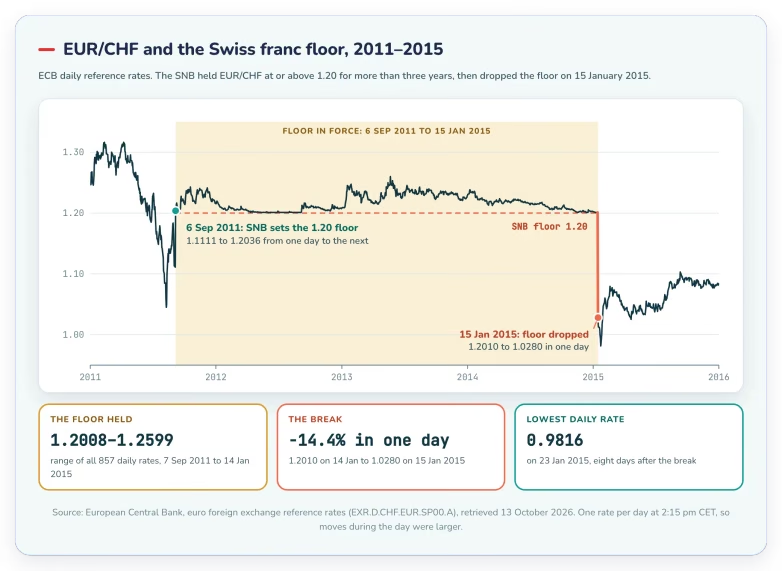
On 6 September 2011, the SNB set a minimum exchange rate of 1.20 francs per euro. This floor was a one-sided peg: the SNB stopped the franc from strengthening past 1.20 per euro, but EUR/CHF could still trade above it.
The floor held for more than three years. On all 857 daily ECB reference rates from 7 September 2011 to 14 January 2015, EUR/CHF stood between 1.2008 and 1.2599. On 18 December 2014, the SNB reaffirmed the floor and said it would keep enforcing it with full determination.
Four weeks later, on 15 January 2015, the SNB dropped the floor and cut its interest rate on sight deposits to -0.75%. It said the monetary policies of the major currency areas were moving apart, so enforcing the minimum rate was no longer justified.
The ECB reference rate for EUR/CHF fell from 1.2010 on 14 January to 1.0280 on 15 January, 14.4% in one day, and reached 0.9816 on 23 January. The ECB sets only one reference rate a day (today from a concertation of central banks around 14:10 CET), so these figures understate the intraday swings.
In a TradeGATEHub special-guest stream hosted by Coach Dale Pinkert on 30 June 2022, guest Joseph Wang noted that the SNB likes to surprise markets and once surprised them by letting go of the peg (22:15). Later he set that against the Federal Reserve: “They'll actually tell you straight up what they're going to do” (25:54).
That contrast is the lesson. A central bank cannot easily warn that its peg will end, because a warning would invite the selling it is trying to stop. Exits tend to arrive without notice, sometimes soon after a firm reaffirmation.
What a peg means for forex traders
- Expect ranges, not trends. The whole permitted range of USD/HKD, 7.75 to 7.85, is 1,000 pips. That leaves little room for trend-following and breakout trading strategies.
- Know where the risk sits. On a pegged or floor-protected pair, the main risk is a rare, large jump when policy changes.
- Watch for strain. Falling reserves, a price stuck at the weak edge of the band, jumps in local interest rates and official denials of devaluation talk can all signal pressure. Forward and futures prices can show it while the exchange rate’s current trading level still sits at the parity, as with the bets against the riyal in 2016.
- Treat a stop-loss as an instruction, not a promise of price. A triggered stop becomes a market order and fills at the next available price. After a policy announcement, or when trading reopens after the weekend, that fill can land far from your stop. Our guide to the best time to trade forex covers the weekly open.
Run the Numbers
Illustrative example, not real fills. A trader buys 1 standard lot of EUR/CHF (100,000 euros) at 1.2020, expecting the 1.20 floor to hold, and sets a stop-loss at 1.1970. On EUR/CHF, one pip is worth CHF 10 per standard lot, so the planned risk is 50 pips, or CHF 500.
Then the floor is removed. Say the first price at which the stop can fill is 1.0500. The stop triggers and fills there, 1,520 pips below the entry, for a loss of CHF 15,200. That is about 30 times the planned risk. The stop worked as designed; the gap is what made it expensive.
Position size is the part of this risk you control. Before you trade a pegged or floor-protected pair, work out what a one-day move of 10% to 15% would do to your account, and size the trade so the result is a loss you could accept. Our forex trading for beginners guide shows how to size a position around a stop-loss.
Paddle Out
Want to practise this before you trade live? Open a free forex demo account with Tradeview Markets. You set the virtual balance yourself, so you can practise sizing positions and placing stop-loss orders at the scale you plan to trade. A demo cannot recreate the stress of a real gap, but it lets you learn the mechanics first, the same idea as learning on a trading demo account. When you are ready, compare our low-spread account options.
FAQ
Why do countries have fixed exchange rates?
For stability. A peg makes prices predictable for traders and investors, and it lets a small economy borrow the inflation credibility of a larger one. Economies paid mostly in one currency, such as oil exporters paid in US dollars, often peg to that currency.
What is a floating exchange rate?
It is a rate set by supply and demand in the forex market. The central bank defends no target level, although it may step in to calm disorderly moves. The US dollar, the euro, the Japanese yen and the British pound all float.
Is it better to have a fixed or floating exchange rate?
Neither is better in every case. A fixed rate brings stability but gives up independent interest-rate policy and needs large reserves. A floating rate absorbs shocks through the price but moves more from day to day. A peg tends to suit a small, open economy with one main trading partner; large economies with trusted central banks usually float.
Does the US have a fixed or floating exchange rate?
Floating. The IMF classifies the US dollar as free floating. Several other currencies, including the Hong Kong dollar, the Saudi riyal and the UAE dirham, are pegged to it.
What are the different types of foreign exchange rates?
In policy terms there are three: fixed (pegged), floating and managed floating. The IMF uses 10 categories in four groups: hard pegs, soft pegs, floating and other managed. As of April 2023, 58.2% of IMF members had a hard or soft peg.
How often do fixed exchange rates change?
Rarely. A pegged rate moves only inside its band, and the official rate changes only by a policy decision, such as a devaluation or an exit from the peg. Floating rates move whenever the forex market is open.
What is the most accurate exchange rate?
There is no single official world rate. The usual benchmark is the mid-market rate, halfway between the buying and selling prices, and central banks such as the ECB publish daily reference rates. The rate you get includes a spread or fee. For a pegged currency, the central bank's published rate is the anchor.
Risk warning. Trading involves a high level of risk and is not suitable for every investor. Pegged and floor-protected currency pairs can gap sharply when a central bank changes policy, and a stop-loss order may then fill far from its level. This article is for educational purposes only and does not constitute financial advice or a recommendation to trade. Tradeview Ltd. is licensed to carry on securities investment business and is regulated by the Cayman Islands Monetary Authority (CIMA) as a full securities broker-dealer (licence no. 585163), 13 Genesis Close, 4th Floor, Suite 422, Cayman Islands.


Community
Trading platforms
Services
Articles
Community
Trading platforms
Services


Copyright © 2026. All rights reserved.
There is a risk of loss in trading foreign currencies and it is not suitable for everyone. Tradeview is not responsible for any gains or losses on currency rates or exchanges during any transaction.
The services and products offered by Tradeview are not being offered within the United States (US) and not being offered to US Persons, as defined under US law. The information on this website is not directed to residents of any country where FX and/or CFDs trading is restricted or prohibited by local laws or regulations.
CFDs are complex instruments and come with a high risk of losing money rapidly due to leverage. 64% of retail investors' accounts lose money when trading CFDs with Tradeview. You should consider whether you understand how CFDs work and whether you can afford to take the high risk of losing your money.
Headquarters Tradeview Ltd.: 13 Genesis Close, 4th Floor, Suite 422, Cayman Islands
High Risk Warning: Foreign exchange trading carries a high level of risk that may not be suitable for all investors. Leverage creates additional risk and loss exposure. Before you decide to trade foreign exchange, carefully consider your investment objectives, experience level, and risk tolerance. You could lose some or all your initial investment; do not invest money that you cannot afford to lose. Educate yourself on the risks associated with foreign exchange trading and seek advice from an independent financial or tax advisor if you have any questions.
Advisory Warning: Tradeview provides references and links to selected blogs and other sources of economic and market information as an educational service to its clients and prospects and does not endorse the opinions or recommendations of the blogs or other sources of information. Clients and prospects are advised to carefully consider the opinions and analysis offered in the blogs or other information sources in the context of the client or prospect's individual analysis and decision making. None of the blogs or other sources of information is to be considered as constituting a track record. Past performance is no guarantee of future results and Tradeview specifically advises clients and prospects to carefully review all claims and representations made by advisors, bloggers, money managers and system vendors before investing any funds or opening an account with any Forex dealer. Any news, opinions, research, data, or other information contained within this website is provided as general market commentary and does not constitute investment or trading advice. Tradeview expressly disclaims any liability for any lost principal or profits without limitation which may arise directly or indirectly from the use of or reliance on such information. As with all such advisory services, past results are never a guarantee of future results.