What Is a Base Currency in Forex? A Beginner’s Guide
The base currency is the first currency in a forex pair. The price always tells you what one unit of it costs in the second currency, called the quote currency. So EUR/USD at 1.0850 means one euro costs 1.0850 US dollars.
That one rule tells you what you buy when you click “buy”, how big your trade is, and which currency your profit or loss lands in. This guide covers how to read it, why some pairs start with the euro and others with the dollar, how crosses work, and how a result becomes money in your account. If forex is new to you, start with what forex is and how the market works.
What is a base currency?
A currency pair compares two currencies. The base currency sits on the left and always counts as exactly one unit. The quote currency sits on the right and shows how many of its units you need to buy that one unit. Traders also call the quote currency the counter or terms currency.
You will see the same pair written as EUR/USD, EURUSD or EUR.USD. The format changes, but the order does not: the first three letters are the base.
| Pair | Base currency | Quote currency | Price | Read it as |
|---|---|---|---|---|
| EUR/USD | Euro (EUR) | US dollar (USD) | 1.0850 | €1 costs $1.0850 |
| USD/JPY | US dollar (USD) | Japanese yen (JPY) | 150.00 | $1 costs ¥150.00 |
| GBP/USD | British pound (GBP) | US dollar (USD) | 1.2765 | £1 costs $1.2765 |
| EUR/GBP | Euro (EUR) | British pound (GBP) | 0.8500 | €1 costs £0.8500 |
Prices in this table are illustrative.
In Plain Terms. The base currency is the thing being priced. The quote currency is the money you price it in. Read any quote out loud as “one [base] costs [price] [quote]” and you will not read it backwards.
How to read a quote from the base currency
When the price goes up, the base currency has gained on the quote currency: one unit of the base now costs more. When the price goes down, the base has lost ground. If EUR/USD moves from 1.0850 to 1.0900, the euro got stronger against the dollar. You can also say the dollar got weaker against the euro. It is one move, seen from two sides.
Two rules handle every conversion:
- From the base, multiply. €10,000 at EUR/USD 1.0850 is 10,000 × 1.0850 = $10,850.
- To the base, divide. $10,000 at the same rate is 10,000 ÷ 1.0850 = €9,216.59.
To flip a pair, divide 1 by the price. EUR/USD at 1.0850 becomes USD/EUR at 0.9217, so one dollar costs about 0.92 euros. It is the same exchange rate, written the other way round. Trading platforms show the standard order, not the flipped one.
A quote only moves when the value of one currency shifts against the other. Where a government pegs its currency, the quote barely moves. In the Federal Reserve’s H.10 data for 5–9 October 2026, the Hong Kong dollar stayed between 7.8469 and 7.8484 per US dollar, because Hong Kong keeps it in a band of HK$7.75–7.85 to one US dollar. Our guide to the fixed exchange rate explains how pegs like this work.
What you buy and sell: the base side of a trade
Every forex order acts on the base currency.
- Buy the pair (go long): you buy the base and sell the quote. You gain if the base gets stronger.
- Sell the pair (go short): you sell the base and buy the quote. You gain if the base gets weaker.
Trade size counts in base units too. One standard lot is 100,000 units of the base, a mini lot is 10,000 and a micro lot is 1,000. Buy one standard lot of EUR/USD at 1.0850 and you hold €100,000, worth $108,500 in the quote currency. Our forex trading for beginners guide walks through placing that first order.
Mind the Undertow. A rising chart does not always mean a rising dollar. The US dollar is the quote currency in EUR/USD but the base currency in USD/JPY. So when the dollar gets stronger against both, EUR/USD falls while USD/JPY rises. Before you read a chart as “the dollar is up”, check which side of the pair the dollar sits on.
Which currency is the base? The quoting order
Nothing stops anyone from writing JPY/USD. The market just doesn’t, by custom. For the eight major currencies, the usual order is:
EUR → GBP → AUD → NZD → USD → CAD → CHF → JPY
In a pair of any two of these, the one further left is the base. That is why you see EUR/GBP, GBP/AUD, AUD/NZD, NZD/USD, USD/CAD, CAD/CHF and CHF/JPY. The eight currencies make 28 possible pairs (8 × 7 ÷ 2), and this order gives the base for each one.
The usual order: the euro is the base against the other seven, the yen is the quote against the other seven, and the US dollar sits in the middle.
Central banks publish their rates in the same order. The European Central Bank quotes every currency against the euro, which it names as the base currency (ECB). The US Federal Reserve’s H.10 release lists the euro, the pound and the Australian and New Zealand dollars in US dollars per unit, and every other currency in units per US dollar (Federal Reserve, H.10). Here is how its rates for 9 October 2026 map onto the symbols you see on a platform:
| Currency in H.10 | How the Fed quotes it | 9 Oct 2026 | Market symbol | Base |
|---|---|---|---|---|
| Euro | US dollars per euro | 1.1193 | EUR/USD | EUR |
| British pound | US dollars per pound | 1.3229 | GBP/USD | GBP |
| Australian dollar | US dollars per Australian dollar | 0.6979 | AUD/USD | AUD |
| New Zealand dollar | US dollars per New Zealand dollar | 0.5611 | NZD/USD | NZD |
| Canadian dollar | Canadian dollars per US dollar | 1.4269 | USD/CAD | USD |
| Swiss franc | Swiss francs per US dollar | 0.8308 | USD/CHF | USD |
| Japanese yen | Yen per US dollar | 158.34 | USD/JPY | USD |
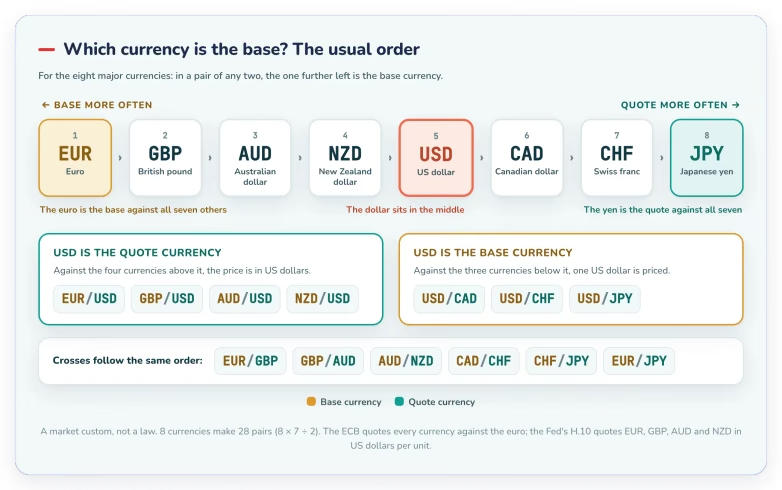
Look at USD/CHF. The dollar is the base even though one dollar bought less than one franc that day (0.8308). The order is a market habit, not a ranking of which currency is worth more or which economy is bigger. For most other currencies, such as the Mexican peso (USD/MXN) or the South African rand (USD/ZAR), the US dollar is the base.
These conventions describe spot quotes, the prices on the forex spot market. Some currency futures quote a currency the other way round, so check the contract before you copy a view from one market to the other. On a platform such as MT4 or MT5, which Tradeview Markets offers among its trading platforms, the symbol settles any doubt: the first three letters of EURUSD are the base.
Base currency in cross pairs
A cross pair leaves the US dollar out: EUR/GBP, EUR/JPY, GBP/JPY or AUD/NZD. The base rule does not change. In EUR/GBP the euro is the base, so the price shows how many pounds one euro costs.
A cross rate comes from the two dollar pairs behind it (illustrative prices):
- EUR/JPY = EUR/USD × USD/JPY = 1.0850 × 150.00 = 162.75
- EUR/GBP = EUR/USD ÷ GBP/USD = 1.0850 ÷ 1.2765 = 0.8500
When the dollar is the quote in one pair and the base in the other, multiply and it cancels out. When it sits on the same side in both pairs, divide.
A cross compares two currencies that are each the base against the dollar, so traders use it to see which of the two is stronger. Dale Pinkert did this on the TradeGATEHub Live Trading stream of 13 October 2026, “DXY Pullback Beginning” (from about 2:10). He pointed out that EUR/GBP had been heading down, which meant the euro had been weaker than the pound. Of the two dollar pairs, EUR/USD had been the softer one and GBP/USD the firmer one. Which of the two a trader picks depends, in his words, “upon which way you’re trading dollar”. We share it as a teaching example of the base currency at work in a cross, not as a trade recommendation.
How the base currency affects pip value and profit
Your profit or loss is first counted in the quote currency, because the price is a number of quote-currency units. A pip is 0.0001 on most pairs and 0.01 on pairs quoted in yen. So one pip on a standard lot of 100,000 base units is worth:
- $10 on pairs quoted in US dollars, such as EUR/USD, GBP/USD, AUD/USD and NZD/USD
- ¥1,000 on pairs quoted in yen, such as USD/JPY and EUR/JPY
- £10 on pairs quoted in pounds, such as EUR/GBP
Your platform then converts that result into your account currency at the current rate.
Run the Numbers. Three trades of one standard lot, each gaining 50 pips, for a trader with a US dollar account. Prices are illustrative.
1. EUR/USD 1.0850 → 1.0900: 50 × $10 = $500. The quote currency is already the US dollar, so nothing converts.
2. USD/JPY 150.00 → 150.50: 50 × ¥1,000 = ¥50,000. Going to the base of USD/JPY, so divide: ¥50,000 ÷ 150.50 = $332.23.
3. EUR/GBP 0.8500 → 0.8550: 50 × £10 = £500. Going from the base of GBP/USD, so multiply at 1.2765: £500 × 1.2765 = $638.25.
Same lot size, same 50 pips, three different dollar results. With a euro account, trade 1 converts too: $500 ÷ 1.0900 = €458.72.
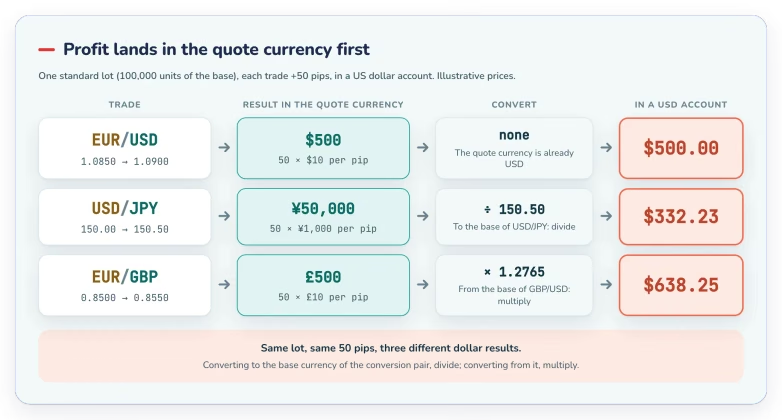
So a pip on USD/JPY is not worth $10 to a dollar account; at 150.50 it is worth about $6.64. On a cross, the value of a pip can drift while the trade is open, because the conversion rate moves as well.
The other meaning: your account’s base currency
“Base currency” has a second meaning. A trading account’s base currency, or account currency, is the currency your balance, margin and profit and loss are shown in. It has nothing to do with the order of a pair. A euro account can trade USD/JPY; the result simply converts into euros.
If your account currency matches the money you deposit and spend, you avoid an extra currency conversion on the way in and out. Tradeview Markets lists USD, EUR, GBP, JPY, CAD, MXN and CHF as account currencies. Check the account currencies available when you open an account; the account types page is the place to start.
In company accounts, the term means the home currency the books are kept in. Either way, it is the currency everything else converts into.
Price currency vs base currency: the CFA notation trap
If you study for the CFA exams or read finance textbooks, you will meet a flipped notation. The CFA Program curriculum writes exchange rates as price currency over base currency, or “P/B” (CFA Institute). In that style, USD/EUR = 1.0850 means one euro costs 1.0850 US dollars. That is the same rate a trading platform shows as EUR/USD 1.0850, and the base currency is the second code, not the first.
The curriculum itself warns that notation varies between sources. Textbooks also use direct quotes, which price one unit of foreign currency in your home currency, and indirect quotes, which do the reverse. Professional FX markets avoid those terms, because what counts as foreign depends on where you sit. Base and quote mean the same thing to everyone. So keep one habit: find the currency that equals one unit. That is the base, whichever side of the slash it sits on.
Paddle Out. The quickest way to make this stick is to watch it happen with some paper trading. Open a free demo account, put EUR/USD and USD/JPY side by side, and see how one move in the dollar shows up in each. Then place a small practice trade on a cross such as EUR/GBP and watch the platform turn the pound result into your account currency.
Frequently asked questions
What is the base and quote currency?
The base currency is the first currency in a pair and always counts as one unit. The quote currency is the second, and the price shows how much of it one unit of the base costs. In GBP/USD at 1.2765, one pound costs 1.2765 US dollars.
Is the US dollar always the base currency?
No. The dollar is the base in USD/JPY, USD/CAD and USD/CHF, but the quote currency in EUR/USD, GBP/USD, AUD/USD and NZD/USD. By market custom, the euro, the pound and the Australian and New Zealand dollars come before the US dollar.
What is the most traded currency?
The US dollar. It is on one side of most forex trades, as the base currency in pairs such as USD/JPY and the quote currency in pairs such as EUR/USD.
How do I tell which currency is the base?
On a trading platform, it is the first three letters of the symbol. In a textbook that uses price/base notation, it is the currency that equals one unit. If in doubt, ask which currency the price is for one unit of.
What is the base currency of a trading account?
It is the currency the account is held in. Your balance, margin and profit and loss are shown in it, and results on pairs in other currencies convert into it.
What are the 7 major currency pairs?
EUR/USD, USD/JPY, GBP/USD, USD/CHF, AUD/USD, USD/CAD and NZD/USD. The US dollar is the quote currency in four of them and the base currency in three.
What are the 28 currency pairs?
Traders usually mean the 28 pairs you can make from the eight major currencies: EUR, GBP, AUD, NZD, USD, CAD, CHF and JPY. The usual quoting order decides the base currency of each one.
Sources
- Federal Reserve Board. Foreign Exchange Rates — H.10, release of 13 October 2026: “Rates in currency units per U.S. dollar except as noted by an asterisk”; the asterisk marks the Australian dollar, euro, New Zealand dollar and British pound (“U.S. dollars per currency unit”). Source of the 9 October 2026 table and the Hong Kong dollar range. federalreserve.gov
- European Central Bank. Euro foreign exchange reference rates: “All currencies quoted against the euro (base currency).” ecb.europa.eu
- CFA Institute (2026). CFA Program curriculum. Currency Management: An Introduction (Level III): currencies are “quoted in terms of a price and a base currency (P/B)”. Currency Exchange Rates: Understanding Equilibrium Value (Level II) notes that notation can vary widely between sources. cfainstitute.org
- TradeGATEHub. TradeGateHub Live Trading | DXY Pullback Beginning, with Dale Pinkert, streamed 13 October 2026 (EUR/GBP point from about 2:10 to 2:28). youtube.com
Risk warning. Trading involves a high level of risk and is not suitable for every investor. Exchange rates can move fast against you, and converting a result from the quote currency into your account currency adds a second exchange-rate risk. This article is for educational purposes only and does not constitute financial advice or a recommendation to trade. Tradeview Ltd. is licensed to carry on securities investment business and is regulated by the Cayman Islands Monetary Authority (CIMA) as a full securities broker-dealer (licence no. 585163), 13 Genesis Close, 4th Floor, Suite 422, Cayman Islands.


Community
Trading platforms
Services
Articles
Community
Trading platforms
Services


Copyright © 2026. All rights reserved.
There is a risk of loss in trading foreign currencies and it is not suitable for everyone. Tradeview is not responsible for any gains or losses on currency rates or exchanges during any transaction.
The services and products offered by Tradeview are not being offered within the United States (US) and not being offered to US Persons, as defined under US law. The information on this website is not directed to residents of any country where FX and/or CFDs trading is restricted or prohibited by local laws or regulations.
CFDs are complex instruments and come with a high risk of losing money rapidly due to leverage. 64% of retail investors' accounts lose money when trading CFDs with Tradeview. You should consider whether you understand how CFDs work and whether you can afford to take the high risk of losing your money.
Headquarters Tradeview Ltd.: 13 Genesis Close, 4th Floor, Suite 422, Cayman Islands
High Risk Warning: Foreign exchange trading carries a high level of risk that may not be suitable for all investors. Leverage creates additional risk and loss exposure. Before you decide to trade foreign exchange, carefully consider your investment objectives, experience level, and risk tolerance. You could lose some or all your initial investment; do not invest money that you cannot afford to lose. Educate yourself on the risks associated with foreign exchange trading and seek advice from an independent financial or tax advisor if you have any questions.
Advisory Warning: Tradeview provides references and links to selected blogs and other sources of economic and market information as an educational service to its clients and prospects and does not endorse the opinions or recommendations of the blogs or other sources of information. Clients and prospects are advised to carefully consider the opinions and analysis offered in the blogs or other information sources in the context of the client or prospect's individual analysis and decision making. None of the blogs or other sources of information is to be considered as constituting a track record. Past performance is no guarantee of future results and Tradeview specifically advises clients and prospects to carefully review all claims and representations made by advisors, bloggers, money managers and system vendors before investing any funds or opening an account with any Forex dealer. Any news, opinions, research, data, or other information contained within this website is provided as general market commentary and does not constitute investment or trading advice. Tradeview expressly disclaims any liability for any lost principal or profits without limitation which may arise directly or indirectly from the use of or reliance on such information. As with all such advisory services, past results are never a guarantee of future results.