What Is Leverage in Trading? A Clear Explainer

Leverage lets you control a large position with a small deposit — effectively borrowing from your broker to size up. It can multiply your gains, but it multiplies your losses just as fast. Leverage is the single biggest reason beginners blow up accounts, so understanding it is essential. This guide covers how it works, a worked example, and how to use it safely.

What is leverage?
Leverage is expressed as a ratio — 1:10, 1:30, 1:100 — showing how much larger a position you can control versus your own deposit. At 1:30, a $1,000 deposit controls a $30,000 position. The rest is effectively borrowed, and your deposit acts as margin, the collateral the broker holds.
How leverage works
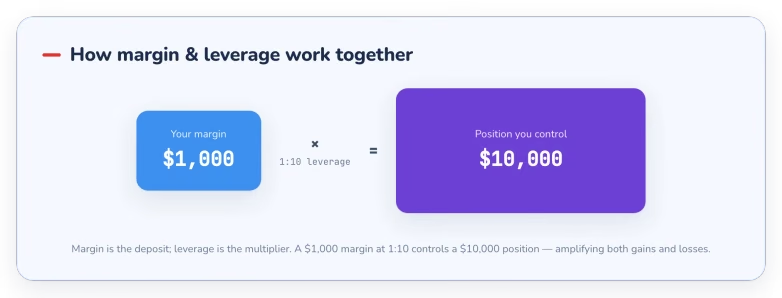
Leverage multiplies the effect of every price move on your capital:
- At 1:10, a $1,000 deposit controls $10,000. A 5% move earns (or loses) $500 — a 50% swing on your deposit.
- At 1:30, the same 5% move is a $1,500 swing — 150% of your deposit.
The percentage the market moves is small; the percentage your capital moves is amplified by the leverage. That cuts both ways, exactly.
Leverage varies by market and region
| Market | Typical retail cap (EU) |
|---|---|
| Major forex | 1:30 |
| Major indices | 1:20 |
| Commodities | 1:10 |
| Individual shares | 1:5 |
Regulators cap retail leverage differently — Europe limits major forex to 1:30, while some jurisdictions allow much more. Higher available leverage isn’t a target to max out; it’s a risk to manage.
The double-edged risk
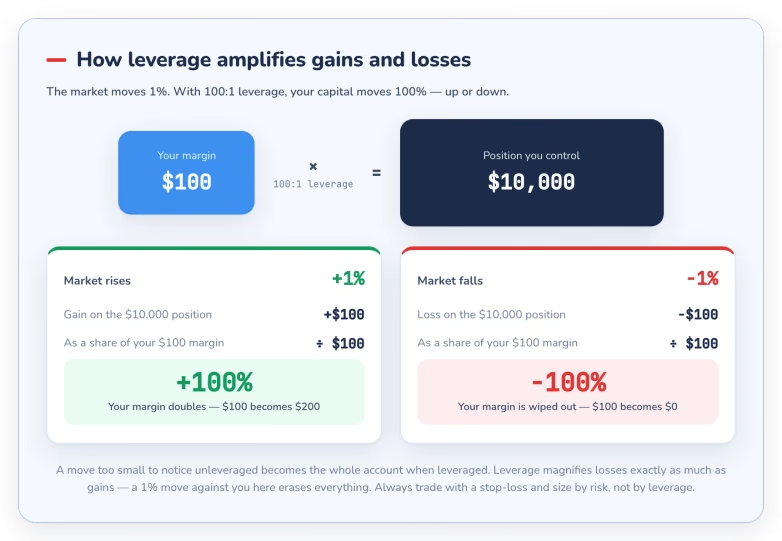
Leverage is neutral — it amplifies whatever happens. Used with discipline it lets modest capital trade meaningfully; used carelessly it turns a small adverse move into a wiped-out account, and can even push your balance below zero. A 3.3% move against a 1:30 position erases the entire deposit. This is why leverage is powerful and dangerous in equal measure, and why it’s central to CFD trading.
How to use leverage safely
- Use less than the maximum. Just because you can trade 1:30 doesn’t mean you should — Tradeview’s dynamic leverage can also scale down automatically as your position size grows.
- Size by risk, not by leverage. Decide your dollar risk first (the 1% rule), then size the position — see risk management.
- Always use a stop-loss to cap the amplified downside.
- Keep a margin buffer so normal swings don’t trigger a margin call.
Be clear-eyed: leverage can cause losses that exceed your deposit. It magnifies losses as much as gains. Only trade money you can afford to lose.
Frequently asked questions
What does 1:30 leverage mean?
You can control a position 30 times your deposit — $1,000 controls $30,000. It multiplies both gains and losses by that factor.
Is high leverage good or bad?
Neither by itself — it amplifies results. Used with tight risk control it’s a tool; used to over-size, it’s the fastest way to blow up an account.
What’s the difference between leverage and margin?
Leverage is the ratio (1:30); margin is the deposit that ratio requires (about 3.3%). They describe the same thing from two angles.
Can leverage put me in debt?
It can, in extreme moves. Don’t assume negative-balance protection will save you — account terms can hold you liable for a negative balance, so never rely on it. Use stop-losses and size positions conservatively.
Sources
- European Securities and Markets Authority (2018). ESMA agrees to prohibit binary options and restrict CFDs to protect retail investors — leverage drives losses; 74–89% of retail CFD accounts lose money. esma.europa.eu
Risk warning. CFDs are complex instruments and come with a high risk of losing money rapidly due to leverage. 64% of retail investors’ accounts lose money when trading CFDs with Tradeview. You should consider whether you understand how CFDs work and whether you can afford to take the high risk of losing your money. This article is for educational purposes only and does not constitute financial advice. Issued by Tradeview Ltd, Cayman Islands.


Community
Trading platforms
Services
Articles
Community
Trading platforms
Services


Copyright © 2026. All rights reserved.
There is a risk of loss in trading foreign currencies and it is not suitable for everyone. Tradeview is not responsible for any gains or losses on currency rates or exchanges during any transaction.
The services and products offered by Tradeview are not being offered within the United States (US) and not being offered to US Persons, as defined under US law. The information on this website is not directed to residents of any country where FX and/or CFDs trading is restricted or prohibited by local laws or regulations.
CFDs are complex instruments and come with a high risk of losing money rapidly due to leverage. 64% of retail investors' accounts lose money when trading CFDs with Tradeview. You should consider whether you understand how CFDs work and whether you can afford to take the high risk of losing your money.
Headquarters Tradeview Ltd.: 13 Genesis Close, 4th Floor, Suite 422, Cayman Islands
High Risk Warning: Foreign exchange trading carries a high level of risk that may not be suitable for all investors. Leverage creates additional risk and loss exposure. Before you decide to trade foreign exchange, carefully consider your investment objectives, experience level, and risk tolerance. You could lose some or all your initial investment; do not invest money that you cannot afford to lose. Educate yourself on the risks associated with foreign exchange trading and seek advice from an independent financial or tax advisor if you have any questions.
Advisory Warning: Tradeview provides references and links to selected blogs and other sources of economic and market information as an educational service to its clients and prospects and does not endorse the opinions or recommendations of the blogs or other sources of information. Clients and prospects are advised to carefully consider the opinions and analysis offered in the blogs or other information sources in the context of the client or prospect's individual analysis and decision making. None of the blogs or other sources of information is to be considered as constituting a track record. Past performance is no guarantee of future results and Tradeview specifically advises clients and prospects to carefully review all claims and representations made by advisors, bloggers, money managers and system vendors before investing any funds or opening an account with any Forex dealer. Any news, opinions, research, data, or other information contained within this website is provided as general market commentary and does not constitute investment or trading advice. Tradeview expressly disclaims any liability for any lost principal or profits without limitation which may arise directly or indirectly from the use of or reliance on such information. As with all such advisory services, past results are never a guarantee of future results.