What Is Margin in Trading?

Margin is the deposit you put up to open a leveraged position — a good-faith down payment that lets a small amount of money control a much larger trade, often 20 to 30 times its size. It isn’t a fee; it’s collateral your broker holds while the trade is open. This guide explains how margin works, how it relates to leverage, what a margin call is, and how to manage the risk.
What is margin?
Margin is the portion of your own money required to open and hold a leveraged position. If a broker requires 5% margin, you put up $500 to control a $10,000 position — the other $9,500 is effectively borrowed through leverage. Tighten the requirement to 2% and the same $500 controls $25,000; loosen it to 10% and it controls only $5,000. When you close the trade, that deposit is released back to you (plus or minus your profit or loss).
Margin vs leverage
Margin and leverage are two sides of the same coin:
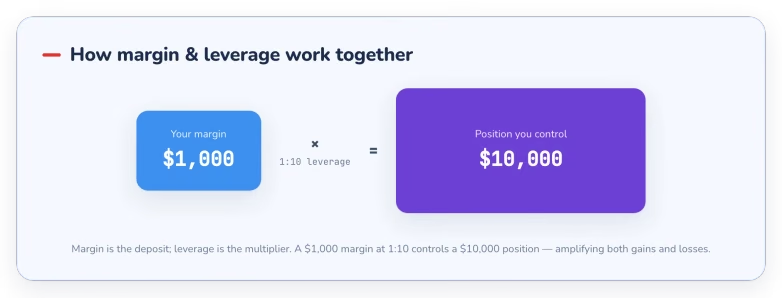
- Leverage is the ratio — 1:20 means you can control 20× your deposit.
- Margin is the deposit that ratio requires — 1:20 leverage means a 5% requirement.
Higher leverage = lower margin required = a bigger position from the same cash, and bigger risk. This is why regulators cap it for retail traders: under ESMA and FCA rules, major forex pairs are limited to 1:30 (a 3.33% margin requirement), non-major pairs and gold to 1:20 (5%), and crypto CFDs to just 1:2 (50%). Professional accounts and offshore brokers may offer more, but the risk scales with it.
Key margin terms
| Term | What it means |
|---|---|
| Used margin | The amount locked up to hold your open trades |
| Free margin | What’s left to open new trades or absorb losses |
| Equity | Your balance plus/minus open profit and loss |
| Margin level | Equity ÷ used margin, shown as a % — above 100% is healthy; below it you risk a call |
What is a margin call?
If your trades move against you, your equity falls. When your margin level drops too close to your used margin — commonly around 100% — the broker issues a margin call, a warning to add funds or reduce positions. If equity keeps sliding to the stop-out level (often near 50%), the broker automatically closes positions to prevent your balance going negative.
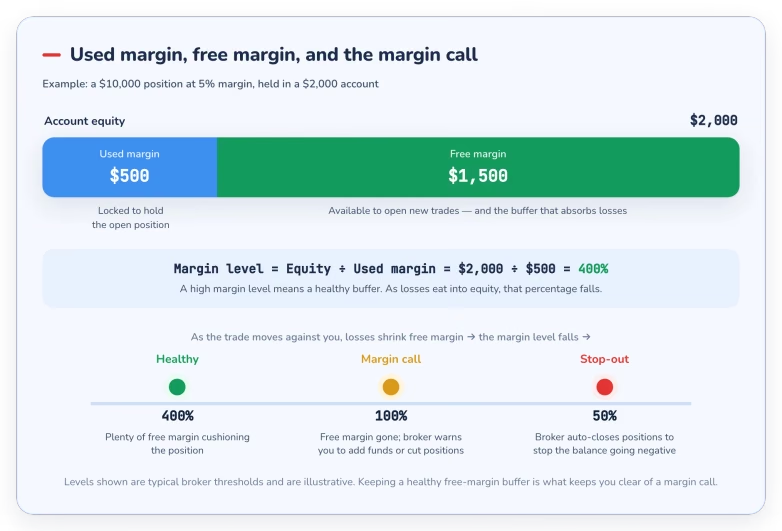
A margin call is the market telling you that you’re over-leveraged. Avoiding it is a core part of risk management.
How to manage margin safely
- Don’t use all your collateral. Many cautious traders keep used margin under 20–30% of equity, leaving a wide free-margin buffer against normal swings.
- Use lower leverage. Just because you can control a huge position doesn’t mean you should — dropping from 1:30 to 1:10 triples the cushion behind every trade.
- Always use a stop-loss. It caps the loss before a margin call becomes likely.
- Watch your margin level. Many platforms show it live, refreshing tick by tick — a healthy buffer well above 100% keeps you in control.
Be clear-eyed: trading on margin can lose money faster than it makes it, and you can lose more than your initial deposit. Only trade money you can afford to lose.
Related guides
Frequently asked questions
Is margin the same as leverage?
No, but they’re linked. Leverage is the ratio (e.g. 1:20); margin is the deposit that ratio requires (5%). More leverage means less margin needed per position.
What happens if I get a margin call?
You’ll be asked to add funds or close positions. If you don’t and losses continue, the broker automatically closes trades at the stop-out level to protect your account.
What is free margin?
The money in your account not tied up in open positions — it’s available to open new trades or absorb losses. Keeping a healthy free-margin buffer reduces margin-call risk.
Can margin trading lose more than I deposit?
It can, because leverage amplifies losses. This is why stop-losses, conservative leverage, and a margin buffer matter so much.
Sources
- European Securities and Markets Authority (2018). ESMA agrees to prohibit binary options and restrict CFDs to protect retail investors — leverage drives losses; 74–89% of retail CFD accounts lose money. esma.europa.eu
Risk warning. CFDs are complex instruments and come with a high risk of losing money rapidly due to leverage. 64% of retail investors’ accounts lose money when trading CFDs with Tradeview. You should consider whether you understand how CFDs work and whether you can afford to take the high risk of losing your money. This article is for educational purposes only and does not constitute financial advice. Issued by Tradeview Ltd, Cayman Islands.


Community
Trading platforms
Services
Articles
Community
Trading platforms
Services


Copyright © 2026. All rights reserved.
There is a risk of loss in trading foreign currencies and it is not suitable for everyone. Tradeview is not responsible for any gains or losses on currency rates or exchanges during any transaction.
The services and products offered by Tradeview are not being offered within the United States (US) and not being offered to US Persons, as defined under US law. The information on this website is not directed to residents of any country where FX and/or CFDs trading is restricted or prohibited by local laws or regulations.
CFDs are complex instruments and come with a high risk of losing money rapidly due to leverage. 64% of retail investors' accounts lose money when trading CFDs with Tradeview. You should consider whether you understand how CFDs work and whether you can afford to take the high risk of losing your money.
Headquarters Tradeview Ltd.: 13 Genesis Close, 4th Floor, Suite 422, Cayman Islands
High Risk Warning: Foreign exchange trading carries a high level of risk that may not be suitable for all investors. Leverage creates additional risk and loss exposure. Before you decide to trade foreign exchange, carefully consider your investment objectives, experience level, and risk tolerance. You could lose some or all your initial investment; do not invest money that you cannot afford to lose. Educate yourself on the risks associated with foreign exchange trading and seek advice from an independent financial or tax advisor if you have any questions.
Advisory Warning: Tradeview provides references and links to selected blogs and other sources of economic and market information as an educational service to its clients and prospects and does not endorse the opinions or recommendations of the blogs or other sources of information. Clients and prospects are advised to carefully consider the opinions and analysis offered in the blogs or other information sources in the context of the client or prospect's individual analysis and decision making. None of the blogs or other sources of information is to be considered as constituting a track record. Past performance is no guarantee of future results and Tradeview specifically advises clients and prospects to carefully review all claims and representations made by advisors, bloggers, money managers and system vendors before investing any funds or opening an account with any Forex dealer. Any news, opinions, research, data, or other information contained within this website is provided as general market commentary and does not constitute investment or trading advice. Tradeview expressly disclaims any liability for any lost principal or profits without limitation which may arise directly or indirectly from the use of or reliance on such information. As with all such advisory services, past results are never a guarantee of future results.